Wednesday, May 29, 2013

The Minnesota Google Summit


Our team from EHSI. We went to the first annual Google in Education Minnesota Summit. It is a one day, hands-on conference that focuses on integrating Google Apps for Education in K-12 and Higher Ed learning environments. All presentations were from the Google Apps for EDU team, Google Certified Teachers and Google Apps for Education Trainers. I went to two sessions on You Tube in the Classroom and how to use Google sites as an content management system and a learning managment system.  All the sessions were awesome and practical and dynamic. 

I applied to be a presenter at the Google Summit.  I was not chosen, but someday I will be!

Here is my application:
Lynnea West will present on how to use a Moodle course and Google Apps together for differentiated, reflective, creative learning.

Last spring, a group of teachers wrote content and process for the Minnesota History Project, a collaborative curriculum project facilitated by District 287.  This 2012-2013 school year, the digital social studies content is being piloted by Lynnea West.  Sixth grade students have an opportunity to participate in a hybrid model of learning with technology and traditional textbook materials.

The curriculum that is being developed for the Minnesota History Project presents students with multiple authentic opportunities to take in diverse perspectives, to think critically about past events, and to communicate their own understanding in a variety of formats.   In this model, the student is an active participant in the social studies classroom, fully engaged in their own learning.

Google Apps are providing the tools to engage and collaborate on projects in the Moodle course and provide the platform to create an online portfolio of learning.

Lynnea is a teacher as a profession, and also a parent to two Spanish immersion students.  This position is the grand intersection of where her heart is and her head and hands work.

Lynnea has always enjoyed working with children, families and learning in her previous positions as a Peace Corps Volunteer in Mali, West Africa and working as a project coordinator at Big Brothers and Big Sisters of Minneapolis.

Lynnea finished her Masters of Arts in Curriculum and Instruction at the University of St.Thomas with her thesis on Literacy and Technology.

Lynnea has many years teaching in public schools.  She taught first grade, second grade, fourth grade in a looping program and third grade English Language Arts at Normandale French Immersion School.  Lynnea has been the English Language Arts PLC team lead in third through sixth grades for five years at Eagle Heights Spanish Immersion School in Eden Prairie.

This year she is adding 6th Grade Social Studies Teacher to her repertoire by piloting a collaboratively created digital curriculum with District 287.

Lynnea is married to another educator and they have two beautiful daughters.  The girls keep them awfully busy with school activities, guitar lessons, dance classes and many adventures. Otherwise, she loves to go to yoga classes, knit, eat sushi, and read books for her book club.


Monday, April 29, 2013

iLearn Coordinator


I will have a new job starting July 1, 2013!

Eden Prairie School District will have six ilearn Coordinator positions. The role of these positions is to provide leadership, support, and build capacity in instructional staff to use technology that supports and personalizes learning. Eden Prairie is a school district with over 1,500 employees serving 9,800 students. The district is recognized for its quality initiatives and its leadership in educational programming.

Eden Prairie Schools is beginning the journey to put more technology in the hands of students and teachers through an effort called "i-LEARN@EP." The phrase "digital conversion" refers to our transition from a paper-based system of fixed content (i.e. textbooks, tests and assignments on paper) to a digital (technology) based system of adaptive content where students and teachers use technology devices to access and create content as an integral part of the learning process. Teachers have used different technology tools in creative ways and have found different ways to engage students. The use of digital devices is the logical next step in this evolution.

I am THRILLED to be offered this opportunity.  I anticipate alot of WOW.  I am over the moon!

Tuesday, April 9, 2013

Turning to One Another


I loved this. A friend sent it to me.  I think it has so many ways to be applied.  It can be used as a guiding principle with coaching other teachers, in working with colleagues, in talking with adolescents, in all our loving relationships.

Turning To One Another
by Margaret Wheatley
 
There are many ways to sit and listen for the differences.  Lately, I’ve been listening for what surprises me.  What did I just hear that startled me?  This isn’t easy – I’m accustomed to sitting there nodding my head to those saying things I agree with.  But when I notice what surprises me, I’m able to see my own views more clearly, including my beliefs and assumptions.

Noticing what surprises and disturbs me has been a very useful way to see invisible beliefs.  If what you say surprises me, I must have been assuming something else was true.  If what you say disturbs me, I must believe something contrary to you.  My shock at your position exposes my own position.  When I hear myself saying, “How could anyone believe something like that”? a light comes on for me to see my own beliefs.  These moments are great gifts.  If I can see my beliefs and assumptions, I can decide whether I still value them.

I hope you’ll begin a conversation, listening for what’s new.  Listen as best you can for what’s different, for what surprises you.  See if this practice helps you learn something new.  Notice whether you develop a better relationship with the person you’re talking with.  If you try this with several people, you might find yourself laughing in delight as you realize how many unique ways there are to be human. 

We have the opportunity many times a day, every day, to be the one who listens to others, curious rather than certain.  But the greatest benefit of all is that listening moves us closer.  When we listen with less judgment, we always develop better relationship with each other.  It’s not differences that divide us.  It’s our judgments about each other that do.  Curiosity and good listening bring us back together. 

Sometimes we hesitate to listen for differences because we don’t want to change.  We’re comfortable with our lives, and if we listened to anyone who raised questions, we’d have to get engaged in changing things.  If we don’t listen, things can stay as they are and we won’t have to expend any energy.  But most of us do see things in our life or in the world that we would like to be different.  If that’s true, we have to listen more, not less.  And we have to be willing to move into the very uncomfortable place of uncertainty.

We can’t be creative if we refuse to be confused.  Change always starts with confusion’ cherished interpretations must dissolve to make way for the new.  Of course it’s scary to give up what we know, but the abyss is where newness lives.  Great ideas and inventions miraculously appear in the space of not knowing.  If we can move through the fear and enter the abyss, we are rewarded greatly.  We rediscover we’re creative.

As the world grows more strange and puzzling and difficult, I don’t believe most of us want to keep struggling through it alone.  I can’t know what to do from my own narrow perspective.  I know I need a better understanding of what’s going on.  I want to sit down with you and talk about all the frightening and hopeful things I observe, and listen to what frightens you and gives you hope.  I need new ideas and solutions for the problems I care about.  I know I need to talk to you to discover those.  I need to learn to value your perspective, and I want you to value mine.  I expect to be disturbed by what I hear from you.  I know we don’t have to agree with each other in order to think well together.  There is no need for us to be joined at the head.  We are joined by our human hearts.

http://www.ceo.com/wp-content/uploads/2013/01/CEO-and-HR.png

Thursday, March 21, 2013

Anchoring Creativity

In her book, Leading and Managing a Differentiated Classroom, Carol Ann Tomlinson refers to "anchoring activities"as a "task or set of tasks to which students move when they complete an assignment."  One of the challenges in teaching with a Moodle course and digital devices after teaching in a literacy classroom for the last five years, was figuring out what those anchoring activities would be, how to manage them and establish routines for them, thus allowing differentiation practices to happen.

Tomlinson writes:
Characteristics of High Quality Anchor Activities:
  • Activities are focused on essential learning goals (not trivial)
  • Activities are engaging (not rote practice)
  • Activities address a broad range of student interests and help make content relevant for students from a variety of backgrounds.
  • Activities address a broad range of readiness needs and vary from concrete to abstract, structured to open-ended and simple to complex. 
  • Activities allow for a variety of ways of taking in and expressing ideas that address a broad range of learning profile needs.
  • Activities are presented with clear directions so students know what to do, what the final product should be, how they will know when they are finished and what to do with the work they generate.
  • Activities incorporate a monitoring system to the teacher and students can recognize the level of quality produced and any need for adjustment. 
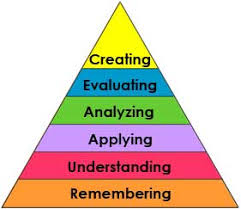
I would suggest that the Bloom's Taxonomy should also be included in the ways to engage students in learning, after the "assignments" have been completed.  Something I have kept in mind in designing the activities, is for sure the "what is going to engage them" but also the "Creating" part of Blooms.  What are ways that they can generate new and creative ways of thinking, products of ways of viewing things?  How can they plan, design, produce or invent a representation of their learning using the digital device?  We started with one at a time, and have gradually increased our repertoire of activities.  So, instead of "anchoring activities" I have been thinking of them as "anchoring creativity." These have been the things that they have WANTED to do, and asked to do.  Oh, and one project that I thought would be engaging was met with a great big FAIL.  Glogster.  Ugh.


Here are examples of some of the anchoring activities we have had during different units of study with the Moodle course:

First, students created a "Googlio" or a Google site used as an efolio.  One of the reflective practices is to have students write about their thinking using a Metacognitive Frame.


Or, students can create timelines to represent different time periods that we are studying.  Alternatively, they can create timelines about their own life for their "All About Me" page. Or, when working on ANY section of time, they can create a timeline about any unit of study. 

Also, once we learned how to make short Animoto videos, they can make different videos about any subject or section in time during our unit of study.

Friday, February 8, 2013

Transformation


Redefinition or Modification?

Either way, I'm happy.


Here is the original paper pencil assignment:
 
Not bad, kind of fun and creative.  I think this student had a little help at home burning the edges of his paper.  :)
 
 
With Technology: 
Using shared Google Presentations from our Google Apps, the students started with a blank template and writing prompt. Blank Template and Writing Prompts: http://goo.gl/hTIOO  In the process, they wrote at the same time, edited and added multimedia elements including primary source images and music.   
Here is the ameliorated technology version:
 
 
Finished Collaborative Writing: http://goo.gl/bz7bg
The level of engagement was so much higher this way.  And, the process was definately more collaborative.  Without the Google presentation, the writing occured on an indiviual level.  This way of writing produced more creative and detailed writing.  The ideas they got from each other made the writing process so much richer. 

We posted the first pages of their presentations out in our hallway, so that families could scan the QR Codes with their smart phones and view the presentations.  The students loved that part, with the thought of them sharing all their work for an authentic audience. 

Collaborate Using Higher Order Thinking

Collaborating Using Bloom's Revised Taxonomy

Higher Order Thinking
Analyzing: Breaking information into parts to explore understandings and relationships. 
Comparing, organizing, deconstruction, interrogating, finding.
 
Creating: Generating ideas, products or ways of viewing things.
Designing, constructing, planning, producing, inventing.
 
 
1. Work in a group of 3 or 4 with the list of words you are given. The words may be listed on notecards, small pieces of paper, or Smart Notebook software.

2. Group the words from our list. Use both electronic and print resources to help identify the people listed. There is no right or wrong way to group the words as long as there are at least 2 words in each group and at least 3 groups.

3. Once all words are grouped, you will need to add labels to each group. Labels can be single words or short phrases.

4. Groups should share their groups and labels with each other, and explain reasoning for groups and labels.

5. After creating and labeling groups, complete the List Group Label Civil War forum response on the Moodle.

Use the following words, and/or add your own. Be sure to copy each word/phrase to a separate notecard or text box so that you can manipulate each into a group:

Abraham Lincoln
Dred Scott
General Robert E. Lee
Mary Schwandt
Henry Sibley
General Ulyssis S Grant
Harriet Tubman
Clara Barton
soldier
Frederick Douglass
Jefferson Davis
Robert Hickmam
Taoyateduta
missionary
Stonewall Jackson
Annie Davis
settler
Dakota
Sojourner Truth
Charley Goddard
Eliza Winston

Response:
What are the labels of your groups? Describe a discussion your group had while doing this activity. Include any disagreements or barriers you encountered while grouping or labeling and how you came to consensus. What have you learned about the Civil War through this activity?
This explanation should be 5-10 sentences.
 
This activity was so successful.  The students all grouped the individuals listed in new and creative ways.  They were so busy talking and researching, I swear, some of them forgot it was an assignment. Thanks to my colleague Kim Christensen for the writing of this strategy into our Moodle course.